

Commentary
Michael Young
{
  "authors": [
    "Michael Young"
  ],
  "type": "commentary",
  "blog": "Diwan",
  "centerAffiliationAll": "",
  "centers": [
    "Carnegie Endowment for International Peace",
    "Malcolm H. Kerr Carnegie Middle East Center"
  ],
  "englishNewsletterAll": "",
  "nonEnglishNewsletterAll": "",
  "primaryCenter": "Malcolm H. Kerr Carnegie Middle East Center",
  "programAffiliation": "",
  "regions": [
    "Syria",
    "Lebanon",
    "Levant",
    "United Kingdom",
    "France"
  ]
}
Source: Getty
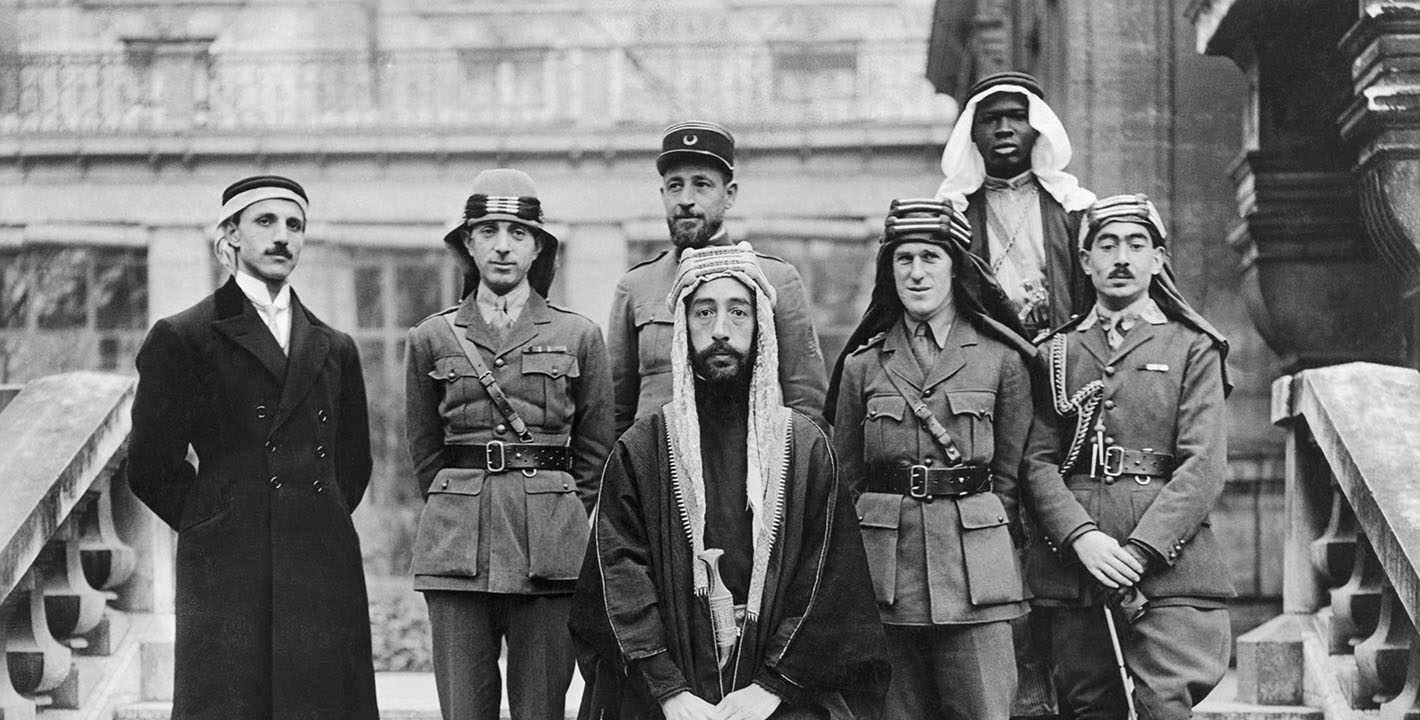
In an interview, Elizabeth Thompson recalls how the country formulated a liberal constitution in 1920, before being denied by France and Britain.
Elizabeth Thompson is professor and Mohamed S. Farsi chair of Islamic peace at the American University in Washington, D.C. She is a historian of social movements and liberal constitutionalism in the Middle East, with a focus on how race and gender relations have been conditioned by foreign intervention and international law. Thompson has authored several books, including Justice Interrupted: The Struggle for Constitutional Government in the Middle East (Harvard, 2013) and Colonial Citizens: Republican Rights, Paternal Privilege, and Gender in French Syria and Lebanon (Columbia, 2000), which won two national prizes. Her third book How the West Stole Democracy from the Arabs: The Syrian Arab Congress and the Destruction of its Historic Liberal-Islamic Alliance (Atlantic Monthly Press, 2020), is a fascinating account of how post-World War I Syria formulated a liberal constitution, only to see the effort thwarted by France and Britain, who sought to establish effective colonies in the former Ottoman Empire. Diwan interviewed Thompson in early June to discuss the latter book.
Michael Young: Your book How the West Stole Democracy from the Arabs: The Syrian Arab Congress and the Destruction of its Historic Liberal-Islamic Alliance examines a key moment in modern Syrian history, the period between November 1918 and July 1920, when we see a thwarted effort to establish an independent Syrian state with a liberal constitution. What are your main takeaways from this period?
Elizabeth Thompson: Thank you for this question. I see two takeaways. First, that left on their own, before colonization, a full spectrum of Syrian leaders committed to a democratic regime. The constitution they adopted in principle, and with full ratification of the first six articles, remains arguably the most democratic constitution in the Arab world to date, reflecting the political culture they inherited as Ottoman citizens. This finding forces us to ask new questions about modern Syrian and Arab political history. My first hypothesis is that the investigation of why the Arab world lacks democracy today must start with the extension of European colonization after World War I, not Islamic culture or the behavior of particular dictators since independence.
Second, a related takeaway is to ask new questions about the rise of authoritarian, violent, and religiously radical movements in the region. My current research explores the ways in which such movements were empowered after the violent destruction of democratic movements after World War I. This puts modern Middle Eastern political history in the same analytical frame of studies examining the rise of anti-liberal, anti-democratic movements in Europe during the same period.
MY: One important reminder in your book is that Prince Faisal, the future king of Syria and later king of Iraq, had reached an agreement on January 6, 1920, with the French prime minister, Georges Clemenceau, that was an effort to reconcile their contradictory aims in Syria. Can you briefly describe the deal, why it was not implemented, and why Faisal came under such criticism for it later, through in retrospect it was better than what came when the French conquered Syria in 1920?
ET: The late French-Lebanese historian Gérard Khoury made this argument in his 1993 book La France et l’Orient arabe. He and other diplomatic historians who are sympathetic to their colonialist sources are correct that Clemenceau had promised a lightweight form of a French Mandate in a provisional agreement dated January 6, 1920. Faisal would have kept his throne in Damascus. French troops would have remained stationed north of Aleppo, to be called in only upon Faisal’s request. But France would have asserted control over the defense of the Syrian hinterland and over its foreign policy. The deal was comparable to what the British offered Egypt shortly afterward.
My problem with Khoury’s argument is that it sees positive aspects of the deal only by comparison with later events that Syrians could not foresee. Also, it ignores context in January 1920 that Syrians clearly did see. Clemenceau was ousted two weeks after the agreement by colonialists secretly determined to violate the 1916 Sykes-Picot Accord’s assurance of self-rule in the “A” zone of the Syrian hinterland. The terms of the January 6 agreement would never have held. Even Faisal understood it was a mirage; that is why he turned to the British. But Faisal’s closest advisors understood better than he did that the British would never protect Syria. Criticism of Faisal later, to my knowledge, focuses more on his slow understanding of the need to prepare a military defense in Syria.
MY: One of your main themes is how the principal Western powers, mainly France and Britain, effectively asserted imperial control over the Middle East, in contravention to Woodrow Wilson’s idea of pushing for self-determination in the former territories of the Ottoman Empire. The instrument for doing so was the mandates system, and you describe in detail how the San Remo Conference in particular was used by the French to push Britain into accepting their control in Syria. Please unpack this for us and explain the role of French official Robert de Caix in this effort?
ET: Yes, colonialists in both France and Britain opposed Wilson’s call for mandates based on consent of the governed, and on an understanding that a principal war goal must be to extend international law to the rights of all nations, including small ones. Theorists have published recently on how radical Wilson’s vision truly was, as it anticipated the logic of late 20th-century human rights campaigns by situating sovereignty in the individual, not the nation. Individual electors were supposed to choose their postwar mandatory power and choose the kind of temporary regime that would quickly equip them to enter the rights-bearing family of nations. Wilson did ensure this consent requirement in Article 22 of the League of Nations covenant on mandates. That article also established that the mandated peoples of the former Ottoman Empire would be granted sovereignty, on condition that they accepted advice under a mandate.
Robert de Caix and his counterparts in Britain opposed Wilson’s ideas from the start. De Caix was a powerful player in the French colonial lobby, with influence over the press and public opinion and a network of supporters inside the French Foreign Ministry and legislature. Clemenceau, French prime minister from November 1917 to January 1920, was one of the colonial lobby’s oldest and staunchest enemies. He had, during the war, defeated colonialists by assuring reforms in Algeria and Senegal in recognition of the sacrifices made by soldiers from those territories. He had little interest in extending the French Empire. But de Caix had thwarted a deal with Faisal in April 1919 and as soon as Clemenceau stepped down, he asserted a major influence on the decision to invade Syria, topple Faisal, and create Greater Lebanon as a separate state. He then defended the violently repressive mandatory regime in Syria as France’s delegate to the League of Nations’ Permanent Mandates Commission.
Gérard Khoury himself remarked that de Caix’s success, as a single influential actor, was quite remarkable. I had the privilege of speaking with Professor Khoury before he passed away in 2017. He lamented the destructive role played by a man who did not, in fact, harbor any personal affection for either the Lebanese or the Syrians. He was a man, as I argue in my book, whose sole motive was to redeem France’s glory through empire.
MY: From a Lebanese perspective, I got the sense that your narrative tended to portray Lebanon’s Maronite Christians as outliers in a general Arab movement toward independence. This tends to meet up with a general Arab nationalist view of the community that views it somewhat negatively. Yet given the Maronites’ autonomy in Mount Lebanon during the latter half of the 19th century, would it be fair to say their yearning for independence could only reach fruition through a foreign power such as France, since they perceived Faisal’s regime in Damascus as one that would have reversed the relative autonomy they had enjoyed?
ET: I am persuaded by the research of Ussama Makdisi on Mount Lebanon and the roots of sectarian violence that peaceful coexistence during the late Ottoman era was achieved by forces from within as much as, or more than, foreign influence. The Maronite Church did not rule the Mutassarifiyya; indeed, as Engin Akarli argued in his The Long Peace: Ottoman Lebanon, 1861-1920, the Church’s ambition was held in check during that period. The Church became, however, the main source of sustenance during the great famine of World War I, and afterward the main beneficiary of French aid. It was my impression, when I wrote my book, that not all Maronite Christians believed the Church’s assurances that a French Mandate would be temporary. More research must be done on the views of ordinary Maronites, and on why the elected Administrative Council of Mount Lebanon, including the Maronite patriarch’s own brother, voted to embrace the Syrian Arab Kingdom in July 1920. That vote occurred after it became clear that the Syrian constitution provided for the autonomy of Lebanon within the kingdom.
MY: One of the key figures in your account is Rashid Rida, who presents an interesting portrait in counterpoint to your book. Rida, a Muslim thinker from Qalamoun, today located in northern Lebanon, played a major role in the establishment of Syria’s liberal constitution by the Syrian National Congress, yet also was the one who later inspired Hassan al-Banna to establish the Muslim Brotherhood in Egypt, which is not generally seen as a liberal movement. Can you explain this paradox?
ET: Thank you for this question. The seeming paradox of Rashid Rida’s role is a major reason I decided to write the book. How could a religious leader, still venerated today by the Muslim Brotherhood, have presided over the drafting of a constitution that disestablished Islam? How and why was this episode forgotten not just by Islamists, but also by scholars who have long since debated the relationship between Islam and democracy? Thanks to religion scholar Umar Ryad, I was able to access Rida’s personal diary kept during the period of the Syrian Arab Kingdom. In combination with his articles published in his journal Al-Manar, it became clear that Rida really did believe in liberal values common to the major religions. He devoted an issue of his journal to praising Woodrow Wilson as an instrument of God. He so believed in Europe’s liberals that he traveled to Geneva in 1921 to make the case against the very illiberal French Mandate.
The epilogue to my book suggests that Rida’s disenchantment with liberalism came when the League of Nations, under control of colonialists such as Robert de Caix and Lord Balfour, ratified the mandates. My current research will look more deeply into how Rida then became the preacher who inspired Hassan al-Banna.
MY: One final question. What is the importance of your book in light of what happened in Syria between 2011 and 2024, when the country descended into unspeakable violence? How can your book frame this period for readers?
ET: You are very kind to suggest that my book has direct relevance today. Such relevance will become clear only through the eyes of Syrians who today try to reconstruct their country. History books, if well written, should enable readers to imagine their present in a new light, and should provide keys to unlock a future unburdened by the tragedies of the past.
That said, I suggest at the end of the book that the violent colonization of Syria split apart the popular democratic coalition, which had tied middle-class democratic leaders to popular classes through popular religious idioms. James Gelvin’s book Divided Loyalties elucidates this popular base well. In response to the failures of liberation both in Syria and Egypt, liberals became elitists who collaborated with Europeans to tutor their unwashed masses, deemed unready for democracy. Meanwhile, Islamists became dogmatists and populists, increasingly hostile to the brand of liberalism that triumphed in 1920. I am currently conducting research on Egypt during this period for a comparative study with Syria. The polarization of liberals and Islamists has since weakened opposition to dictatorship. Bashar al-Assad’s regime understood this well.
I will close my answer with an anecdote on how two Syrian Americans read my book in January 2025, a month after Assad’s downfall. They worked for the U.S. Agency for International Development, or USAID. I received a call from them on or about January 15. They were so excited to learn about the 1920 constitution from my book. They also lamented that it was not part of the conversation in Damascus, where the 1950 constitution had been raised as a model for a post-Baath Syrian regime. The problem was that the 1950 constitution had installed Islam as a principal source of legislation and as the state’s official religion. This was a stance that Rashid Rida had opposed in 1920, because it denied equality to non-Muslim citizens. The two Syrian Americans at USAID asked if I might help to promote the 1920 model to Syrians today. As they spoke, I could only think that a president was to be inaugurated in a few days who had no interest in promoting democracy abroad—or at home. I did not imagine that these two admirers of my book would lose their jobs, as USAID was dismantled the next month.
I will say that the war in Syria and the record of recent history suggest that democracy will flourish if and only if educated Syrians can return to their country and if and only if they embrace a politics of cross-class unity. Islam is not in itself an obstacle to democracy, but it is easy to use it—and any religion—to undermine tolerance, peace, and democracy. Recent events in my own country reaffirm this historical pattern.

Editor, Diwan, Senior Editor, Malcolm H. Kerr Carnegie Middle East Center
Michael Young is the editor of Diwan and a senior editor at the Malcolm H. Kerr Carnegie Middle East Center.
Recent Work
Michael Young
Michael Young
Carnegie does not take institutional positions on public policy issues; the views represented herein are those of the author(s) and do not necessarily reflect the views of Carnegie, its staff, or its trustees.
As negotiations with Iran and Lebanon continue, chaos is at the heart of the Netanyahu government’s calculations.
Michael Young
Trade statistics show why Amman has more reason than Damascus to welcome the improvement in bilateral commerce.

Armenak Tokmajyan
Adversaries are to be degraded so deeply, that reconstitution becomes difficult or impossible.

Nathan J. Brown
Israel is encroaching on the country’s territory, while the Lebanese look askance at one another.

Issam Kayssi
The party’s domestic and regional roles have changed, so Lebanon should devise a disarmament strategy that encompasses this.
Michael Young